Sun result
Start with the recorded local date. If the record sits near a sign change, preserve its time-zone context rather than converting it casually from memory.
Home / Sun and Moon sign calculator
A Sun and Moon sign calculator can show two different chart coordinates from the same birth record. Check the local calendar date for the Sun; check date, local time and birth place for the Moon—especially when the recorded moment is near a boundary.
Start with the recorded local date. If the record sits near a sign change, preserve its time-zone context rather than converting it casually from memory.
Use the date, local time and birth city together. A rounded time should remain labelled as a rounded time when you compare results.
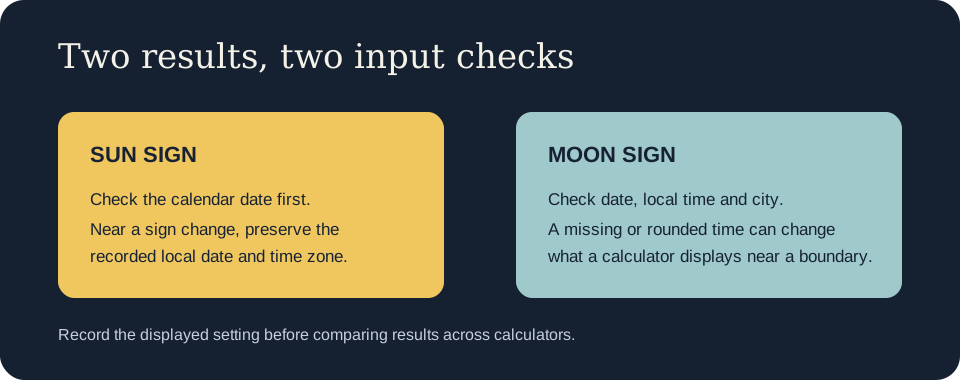
This page’s original contribution is the split-input receipt: preserve the separate check for each displayed label rather than treating “Sun and Moon” as one undifferentiated result.
Sun line: local date, displayed Sun sign, calculator setting.
Moon line: local date, recorded or estimated time, birth city, displayed Moon sign, calculator setting.
Boundary note: if a record is approximate, keep that uncertainty next to the time-sensitive Moon result instead of smoothing it out in the interpretation.
For an Ascendant alongside the Moon, the Moon and Rising Sign Calculator distinguishes a date-stable result from an angle that may stay unresolved. For the full input dependency map, see the birth-chart generator guide.
A calculator can display selected coordinates under its visible settings. It cannot establish a fixed personality, predict an event or resolve a decision for you. Read a chart result as an interpretive prompt only after the input record is clear.
Use the star-chart reading order to validate the record before interpretation, or the find-my-birth-chart checklist if you are still locating it.
For location-based map output, read the astrocartography calculator guide after confirming the same source record.
You can check a date-based result, but keep any time-sensitive uncertainty visible rather than treating an assumed time as evidence.
Compare the date, time, city and visible settings before comparing interpretation text.
No. Use the birth city that belongs with the recorded birth moment.
No. They are separate chart coordinates with different input dependencies; the Rising sign is especially sensitive to time and local place.