Positions
Planets and luminaries are listed in signs and degrees. A sign describes the chart coordinate, while the planet identifies what is being located.
Home / Star chart calculator
A star chart calculator maps planetary positions and chart angles for the date, time and place you enter. First verify the displayed data and settings, then read each result as a specific calculation—not a personality verdict.
Planets and luminaries are listed in signs and degrees. A sign describes the chart coordinate, while the planet identifies what is being located.
The Ascendant and houses depend on local time and place. A time guess cannot turn an unresolved house into a confirmed one.
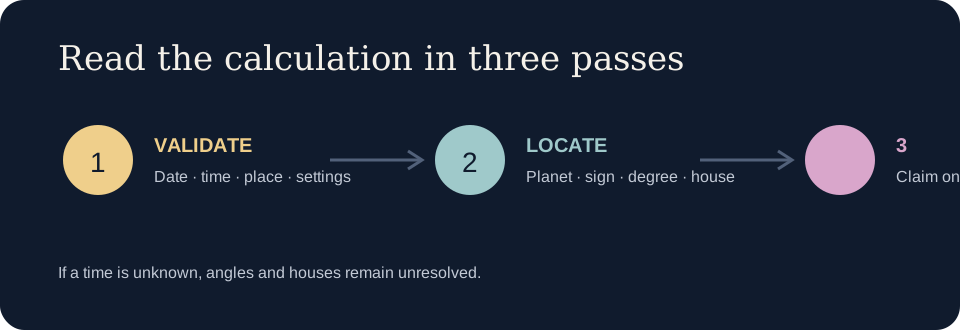
This page’s original contribution is the reading order below: it separates data validation, coordinate reading and interpretation scope. A beautiful wheel invites fast conclusions; a repeatable order makes those conclusions easier to check.
Boundary note: if two calculators disagree, compare their inputs and settings before comparing their interpretation prose. Most useful disagreements are calculation questions first.
Keep the date-stable placements that the calculation can support, but label the Ascendant and houses as unresolved. A noon placeholder may be useful for displaying a wheel; it is not evidence for a particular horizon.
Use the Rising-sign two-result check when you have a defensible time range, and use the birth-chart input map to see which result depends on which field.
In common use, both can mean a chart of the sky for a birth moment. Check the calculator’s settings rather than assuming labels guarantee identical calculations.
Place supplies the local context for angles and houses; it is not merely a profile detail.
Yes for carefully limited date-stable placements, but not for a settled Ascendant or house reading.
Use a separate two-chart method and keep each person’s source data distinct; see the synastry chart calculator guide.