Moon stays in one sign
This page checks the first and last local minute of the date. If both return the same sign, the Moon result is date-stable for that offset.
A RESULT THAT SHOWS ITS LIMIT
Your Moon sign can sometimes be checked across a whole birth date; your Rising sign cannot be confirmed without a recorded time and coordinates. Enter what you have, and this calculator will separate a confirmed result from an unresolved one.
☾
The result will show whether the Moon and Rising signs are calculated, bounded, or unresolved.
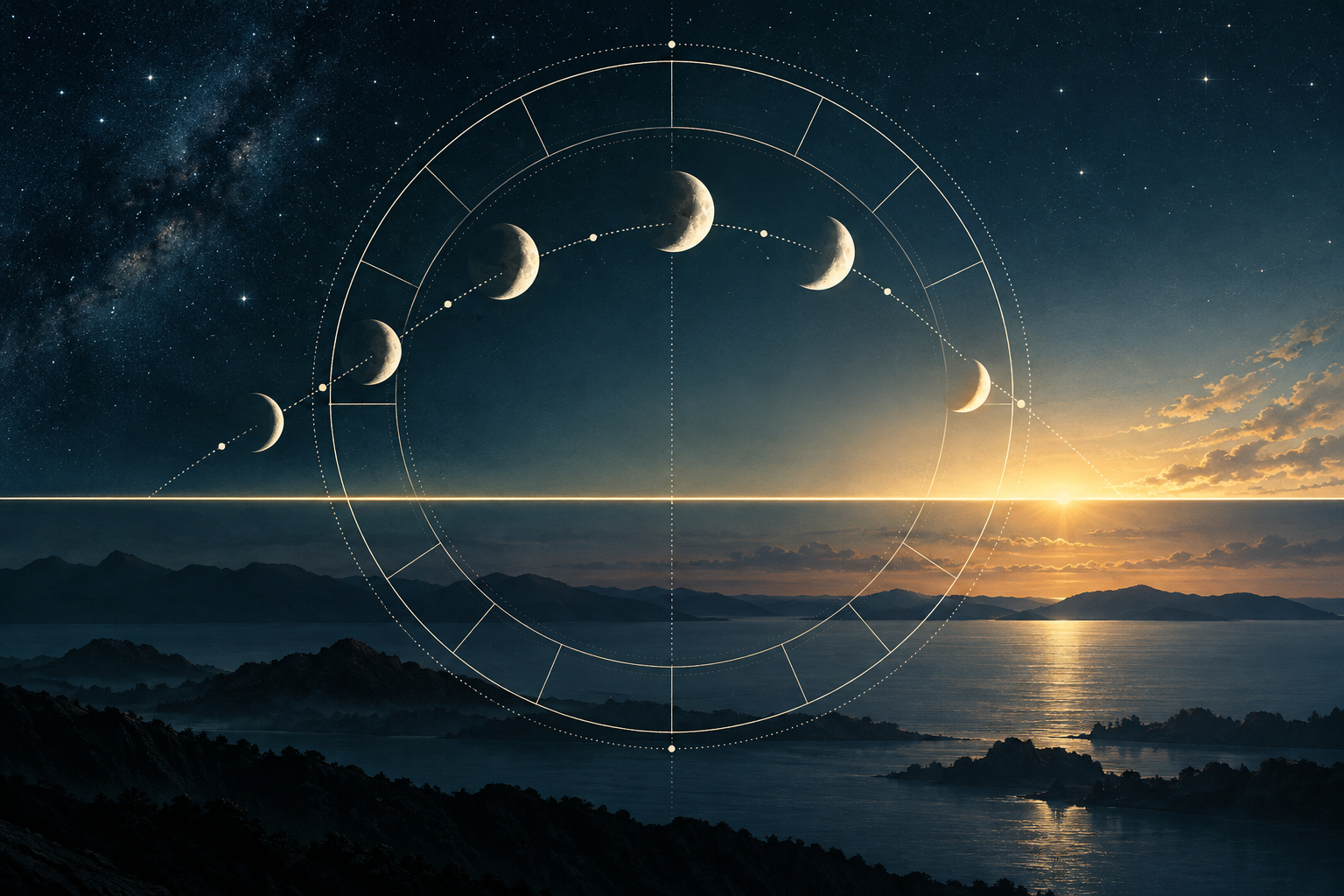
WHEN TIME IS MISSING
This page checks the first and last local minute of the date. If both return the same sign, the Moon result is date-stable for that offset.
The page lists both signs and keeps the Moon unresolved until a recorded time is available.
The Ascendant remains unresolved without a time, UTC offset, latitude, and longitude. Noon is never substituted.
WHY SERVICES DISAGREE
Some Big Three tools collect a name, city, and exact time before they reveal anything. Others allow a no-time entry but limit the output. Neither form alone tells you whether a label is established. The useful distinction is whether the calculation gives the same Moon sign across the date and whether the recorded moment is sufficient for the horizon calculation.
This page shows that distinction beside the result, using a tropical zodiac, Swiss Ephemeris planetary positions, and a Placidus Ascendant when the required inputs exist.
DIRECT ANSWERS
You may be able to confirm the Moon if it stays in one sign for your whole local birth date; a Rising sign still needs a recorded time, UTC offset, and coordinates.
A city name is not a calculation setting. The Ascendant needs coordinates and the historical UTC offset, as well as a time.
No. Use the natal chart calculator for a broader chart view after checking the birth inputs.