Date
Sets the day’s planetary positions and your Sun-sign range. Near a sign change, exact time can still matter for fast-moving bodies.
Home / Birth chart generator
A birth chart generator needs your date, time and place to calculate the sky and chart angles for your birth moment. Start by checking which pieces are known, then read each placement as a three-part coordinate: planet, sign and house—not as one blended label.
Do not treat every field as decoration. A generator uses each input for a different calculation, and a missing field narrows what its result can honestly claim.
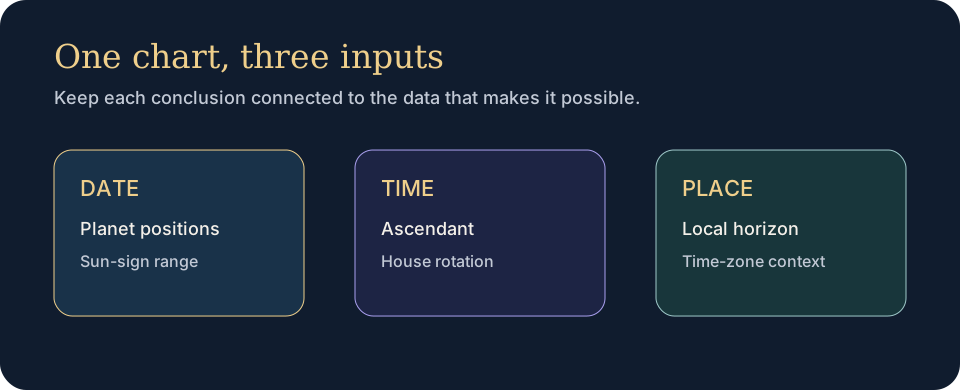
Sets the day’s planetary positions and your Sun-sign range. Near a sign change, exact time can still matter for fast-moving bodies.
Sets the Ascendant and house rotation. It is the field most likely to change house claims rather than planet signs.
Provides the location and time-zone context needed to calculate local angles and houses from a recorded time.
This page’s original contribution is the input-to-claim map: before accepting a polished wheel, match each conclusion to the input that makes it possible. A chart can be useful without every input, but it should not present an unresolved house as confirmed.
Check the entered date, displayed local time, place and zodiac setting. A correct-looking wheel with one wrong field is still the wrong calculation.
Write “Venus in Gemini,” not only “Gemini.” The planet tells you the topic of the symbol; the sign describes its style.
Read the house only if the birth time is reliable. It answers where the placement is placed in the chosen house system, not an extra personality trait.
Keep the time source, location, zodiac and house system beside the chart. This makes a later disagreement solvable instead of mystical.
| If you see | Ask first | Do not silently conclude |
|---|---|---|
| A planet in a sign | Which planet and which zodiac setting? | That it fixes a house placement. |
| A planet in a house | How reliable is the birth time and which house system was used? | That another tool must show the same house. |
| An aspect label | Which two positions and what orb rule? | That sharing a sign automatically creates an aspect. |
Use the date to identify placements that are stable for that date, and leave the Ascendant and houses unresolved. Noon is sometimes used as a placeholder for display, but it is not evidence that noon was your birth time.
Useful notation: write “time unknown—houses not confirmed” next to a saved chart. That one line prevents a provisional wheel from becoming a permanent claim. For a focused time-sensitive check, use the Rising Sign Calculator.
Yes. A browser-based generator can calculate a chart from entered birth data; use it as an interpretive reference and keep the calculation settings with the result.
That depends on the tool. Check the page’s data handling statement; HoroscopeTools calculates its natal chart in the browser rather than asking you to create an account.
Compare the entered time zone, location, zodiac frame, house system and included objects before comparing interpretation text.
Start with the verified header, then Sun, Moon and Ascendant if the time is reliable; see the related rising sign chart check for the angle-specific boundary.